Category Archives: Uncategorized

Gladiators: A Day at the Games

Afternoon Gladiator Battles. Gladiator looking up at the audience for their approval to kill or let the wounded Gladiator live. Photo courtesy of http://www.infosources.org/what_is/Gladiator.html
 
When we think of games today, we usually think of sporting events and the Olympic Games.  In Ancient Rome in the year of 264 B.C.E. the first know gladiatorial games took place.  It was part of the funeral (munera) of Decimus Brutus Pera.  The games would last about 100 days and used about 9,000 beasts and hundreds of gladiators.  A typical day at the games would consist of three parts.  A morning hunt, the lunchtime executions, and finally the afternoon gladiator battles.  At the break of dawn the Roman soldiers would wake up the gladiators and slaves and get them ready to fight for the day.  This involved stretching and practice fighting with wooden swords.  The audience would start to arrive and fill the amphitheatre by the thousands by walking up steep staircases through the walkways known as the ambulacra.  People would come from all over to watch the games.
 
The morning hunts began with the Romans capturing hundreds of animals and dragging them to the amphitheatre to die.  The crowd was always ready to see the capture of some new and exotic beasts fight to the death.  The morning hunt would start off with a bear going up against a bull.  The crowd would cheer and the gates would rise up and the two animals would fight until one animal was dead.  The first bloodshed of the day drew screams and applause from the crowd.  When one of the animals died the crowd would cheer and then fifty venatores would enter the arena. 
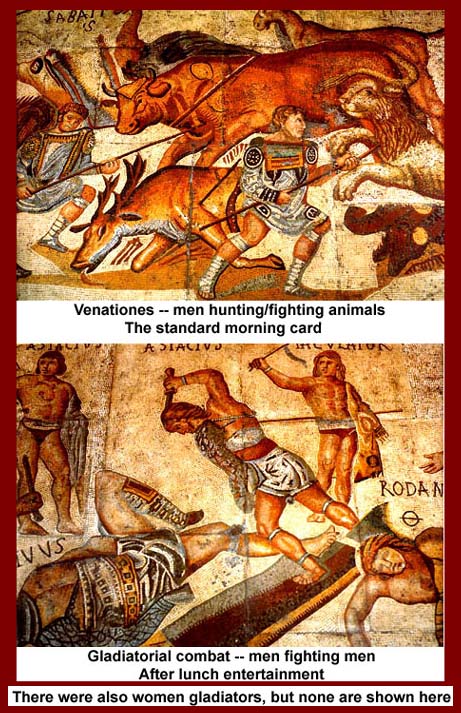
 

The Morning Hunt. Slaves fighting against various kinds of beasts til the death. Afternoon Gladiator Battles on the bottom. Photo courtesy of http://www.mmdtkw.org/ALRIAncRomUnit7Slides.html

 The next battle was slaves against various kinds of beasts.  The slaves would have a variety of weapons for their protection.  Animals that were used in this battle would cosist of elephants, rhinoceroses, lions, tigers, panthers,gazelles, deer, bulls, and bears.  The slaves would then be given dogs that would help them battle the other animals.  Even with all this going on the audience would place bets on which slaves and animals would make it through the fight.  When the last of the slaves survived other slaves would come out and carry the dead humans and animals away.
 
The lunchtime executions was the next event.  This event some stayed for but others they would leave the amphitheatre and eat lunch.  During this time criminals would be executed by means of animals or human executioners.  The criminals were usually charged with murder, arson, and armed robbery.  The audience was pleased to have this part of the games to get rid of the criminals in the cities.
 
The last event would be in the afternoon.  This would involve all the gladiators.  This was the high point of the day for the audience.  The gladiators would enter the arena through the great arch wearing their colored costumes.  The crowd would be going crazy and cheering for their own gladiator that they wanted to win.  When the gladiators made their way to the Emperor’s box the first thing they did before the battles started was the drawing of the lots.  This was done to see which gladiators would be fighting each other.  When this was completed the second important thing to do before the battles was the probatio armorum, or inspection of arms.  They would check every sword, trident, and every bow for sharpness and straightness.  When the battles began it was normally one gladiator against another, however the sponsor or audience could request other combinations like several gladiators against each other or the could be on two separate teams.  At the end of the fight the gladiator would acknowledge defeat by raising a finger to the audience in approval whether the wounded should live or die.  The sponsor or emperor and the audience would point their thumbs in a certain way either for the m to live or die.  It is not clear which way they would point their thumbs.  In some cases the audience would be so impressed on both gladiators they would request that both live to see another day.  A gladiator who would win several fights was allowed to retire.  A retired gladiator would often go to the gladiator school and train other gladiators.
 
Bibliography
 
Baker, Alan: The Gladiator. New York: St. Martin’s Press, 2001


Thomas Wiedemann: “Emperors and Gladiators” Routledge 1992
 
James: “Gladiators” part of the Encyclopaedia Romana
 
Violence and the Romans: The Arena Spectacles
 
The Revolt of Spartacus A narrative essay
 
Daniel P Mannix: “Those About To Die”  Ballantine Books New York 1958
 
Michael Grant: “Gladiators” Penguin Books London 1967 reprinted 2000 ISBN 0140299343


3 Comments

Filed under Uncategorized

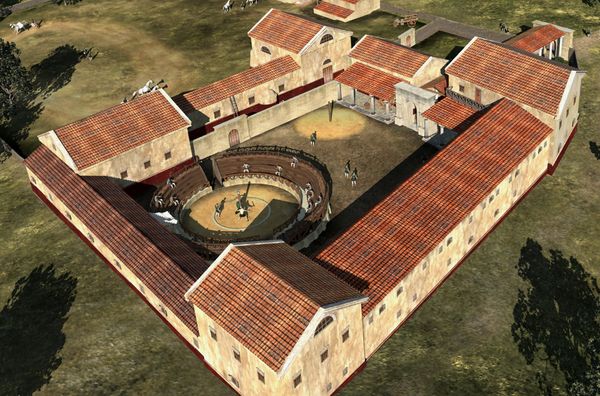
Gladiator Training

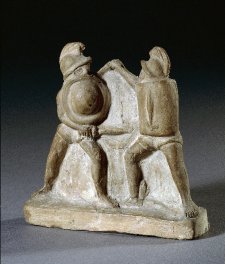
photo courtesy of the British Museum. http://www.britishmuseum.org

                When you mention Gladiator training to people today, they immediately reference the movies Spartacus and Gladiator.  Why is that?  The actors who portrayed these gladiators of ancient Rome resembled the real thing, physically, at least.  The first step in entering a Ludus was being in both fine physical shape, to withstand the training and fights, and be attractive to the masses.

                Gladiators were both slaves and freemen, who elected to renounce their social status.  Before entering training a novice first had to swear an oath agreeing to endure both humiliation and death with honor.  After signing a contract agreeing on a monetary value and the amounts of fights per year, he was then evaluated for what style of fighting he would best be suited for.

                There were five main different fighting styles; a Thraex fought with a relatively small, curved sword (sica) and a small shield (parma).  The parma was used to not only block blows but also to cover the gladiators core section.  Often times, he would also wear long leg-plates.  The Murmillones, named after net fishermen, fought with a long shield (scutum) and a narrow sword (gladius)Like the Thraex, he was also allowed leg-plates, but his could reach no higher than the shin.  The Murmillo was often paired against the Hoplomachus.   His equipment resembled that of the Thraex, but he was afforded a helmet, and instead of a parma, he fought with a round bronze shield.  He would start his fights with a lance, switching to a sica only after being disarmed.  The final gladiator style was the Retairius, he went into battle wearing a loin cloth, with his only protection being a protective wrapping around his left arm and a bronze plate from his left shoulder to his elbow.  His weapons were a circular throwing net and a trident.  While he could be paired against any of the other gladiators, he was mainly paired against the Secutor.  This gladiator resembled the Mumillo with the largest difference being his helmet.  This helmet covered his entire face leaving eye holes to see out of, but it also greatly reduced the gladiator’s field of vision. (Meijer, 2003, 90-93)

                Once the fighting style was chosen the novice would then be assigned to a weapons specialist, normally ex-gladiators who could no longer fight.  Under the care of this specialist, the novice would spend almost every waking moment in the training yard learning the fighting technique, repeating the movements over and over until they knew them automatically.  As their skill progressed, they were moved from practicing with wooden weapons against a wooden pole to blunted weapons against other trainees.  These men would practice until they literally dropped from exhaustion daily. 

                To keep their strength up they were well feed, compared to the general masses.  This was one reason why some freemen volunteered to become gladiators.  Their meals were taken in the canteen along the short edge of the training yard and consisted of barley gruel with beans, vegetables, and brews of charred wood or bone ash. (Curry 2008)  The reason for this was two-fold, the gladiator tended to burn off these calories while in training and when it was time to enter the arena, the added layer of fat acted as a an additional layer of protection.  “If he was wounded, but only in the fatty layer, he could fight on.  It didn’t hurt as much, and the blood looked great for the audience.” (Curry 2008)

                While assigned to a Ludus, the Gladiator was always well fed, and cared for by top physicians.  While most Ludus provided seating for spectators to watch the gladiators spar against each other, the gladiator remained a novice until he entered the arena for the first time.  At this point, he would be given his rating depending upon the outcome of the fight.  Although, we always hear the oath to the Emperor as, “We who are about to die salute you,” it was rare that a gladiator was killed in the arena.  “A gladiator counts it a disgrace to be matched with an inferior, and knows that to win without danger is to win without glory.” (Seneca Ess 1-17)

                Archeologists are continuously uncovering more and more information about the training camps of the gladiator.  From a gladiator cemetery, outside of Turkey, they are learning more on how they died and injuries sustained while both training and fighting.  The equipment used has been uncovered from a Ludus in Pompeii, and a new Ludus has been discovered in Austria, intact.  As we continue to learn more about these athletes of the ancient world, our desire to know more ever increases over time.   The Ludi are best compared to the NFL training camps of today, and these gladiators are best compared to our toughest football players, only our athletes do not have to face death in the arena.

BIBLIOGRAPHY

 Carter, M.J. 2006/2007. Gladiatorial Combat: The Rules of Engagement.  The Classical Association of the Middle West 

     and South 102, no. 2 (Dec-Jan., 2006/2007).   http://www.jstor.org/stable/30038038.  (accessed Sept 18, 2011).

 Curry, Andrew. 2008.  The Gladiator Diet. Archeology 61, no. 6 (Nov-Dec., 2008). 

     http://www.archaeology.org/0811/abstracts/gladiator.html (accessed Sept 18, 2011).

 Meijer, Fik.  2003.  The Gladiators: History’s Most Deadly Sport.  New York: Thomas Dunne Books.

  Seneca. Essays Volume I.  Ess 1-17

  Watson, Traci. 2011.  Huge Gladiator School Found Buried in Austria. National Geographic Daily New,

     September 13, 2011.  http://news.nationalgeographic.com/news/2011/09/110913-gladiator-school-austria-roman-

     ancient-walmarts-science/  (accessed Sept 18, 2011).

3 Comments

Filed under Uncategorized

What song the Sirens sang

“What song the Syrens sang, or what name Achilles assumed when he hid himself among women, though puzzling questions, are not beyond all conjecture.” *

Welcome to the reboot of “What song the Sirens sang.”   This version of the blog will feature posts from students in my various ancient history classes plus occasional posts from me.   I don’t teach every semester, so there will be periods of inactivity.

So, stop by, read, enjoy and perhaps learn.


* From: Sir Thomas Browne. Hydriotaphia (Urn Burial). Ch.5.4, 1658. Ch.5.4, 1658.

Leave a comment

Filed under Uncategorized