I’m all signed up and ready to start blogging!
Tetraites
My name is taken from that of a famous gladiator, Tetraites, who battled valiantly and was even well known in England. He used a sword and shield in his battles and there are paintings of his victory over Prudes, another famous gladiator.
Filed under Uncategorized
lilith4isis
Lilith is my current favorite creation myth. I stumbled across her while I was researching a paper on Gilgamesh and just fell in love with her back-story. According to Hebrew legend she was the first woman created at the same time as Adam. Since they were made from the same stuff at the same time, she believed she was equal to Adam not subservient. So she refused to serve Adam and got cast out of the Garden of Eden and replaced with Eve. Instead of the first feminist with girl power, Lilith is usually portrayed as this evil vengeful demon who seduces men, steals human babies and drinks their blood. Out of this version comes the current stories of her as the mother of all vampires.
My protection dog trainer renamed my puppy Isis so I tacked on her name to my username to make it more unique.
Filed under Uncategorized
History 4210: Ancient History begins Spring 2015
Time to study the ancient world again.
Filed under Uncategorized
Mail in Imperial Rome
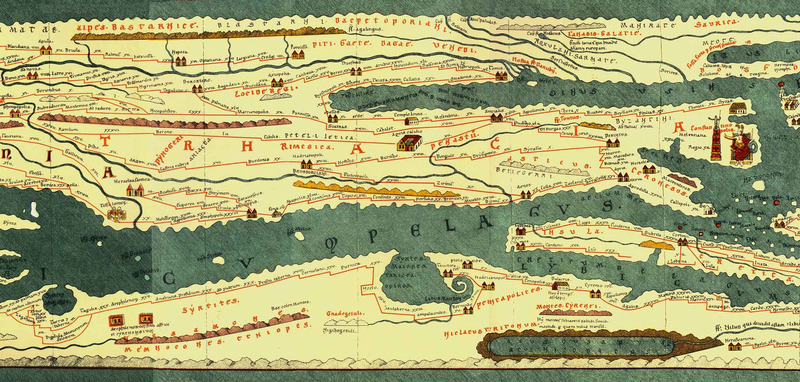
Imperial Rome, with its 80,000 100,000 km[i] network of well-built and maintained roads, had a unique opportunity to provide its citizens and the imperial government with reliable routes for trade, travel, and most importantly communication. Be it the Emperor looking for news of his distant provinces or a mother checking in on the welfare of her traveling son, Romans had a lot to say to a lot of people all across the empire. So, how did these messages, both important and mundane, get from place to place?
The Cursus Publicus
The closest thing to a modern postal system in Rome was known as the cursus publicus. Although it was not mentioned by name until around the fourth century CE,[ii] evidence shows that the cursus publicus was established under Augustus. Perhaps inspired by a similar system that wowed Herodotus in Persia with its speed[iii], the cursus publicus was established to keep both the Italian and far flung provinces of the empire in constant contact with the capital. It was used for all manner of messages including reports on troop movements, rebellions, taxes, and food supply. The cursus publicus was an important piece of infrastructure and was essential in carrying out the business of a huge and geographically wide spread empire.
Initially, a single runner, usually a young man from the local area, would take a message from one relay station on the military road, either on foot or horseback, to the next where the message would be passed by hand to another runner and so on until it reached its final destination. Although it was very fast, this was not a particularly practical way to get word from one military or town post to the next. Most of the time the runner had no knowledge of the message he was carrying so he could not answer any questions about the message itself or conditions in the place the message came from. So, soon after the cursus was established single runners were replaced by a series of carriages (vehiculari) driven by the same courier. This way a single courier could take a message the whole way and if necessary answer any questions the recipeient may have.[iv]
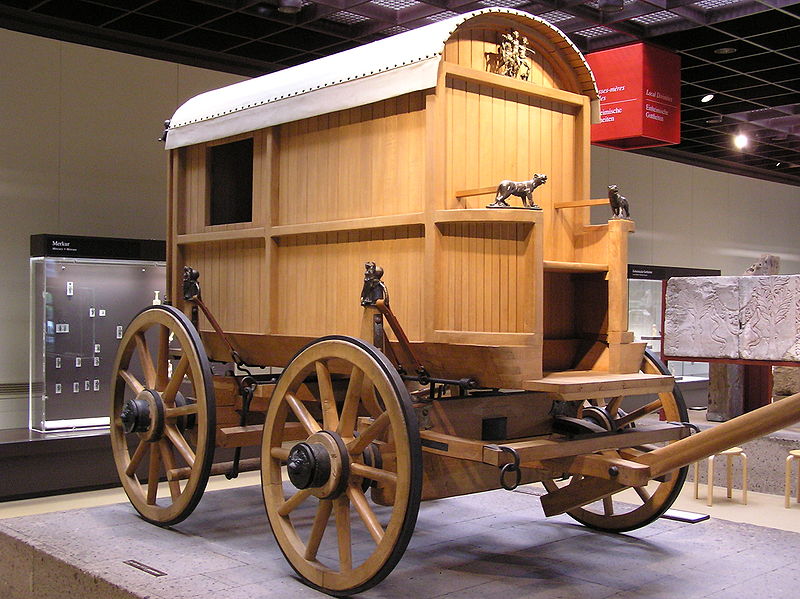
- Wikipedia Commons
Spread out at regular distances along the way, there were two types of way stations; large private homes, known as mansiones[v], where a courier would receive food and lodging as well as blacksmith and stable services for the horses and smaller relay stations known as mutations[vi], where messengers would switch out horses. All services had to be provided by the inhabitants of the town and the operation and cost of maintaining these stations was left up to the public. It was seen as a public service to provide for the men conducting essential imperial business.
The cursus publicus was not a public postal or delivery service. It was strictly a tool of the government. As such, travel on the cursus publicus was highly regulated. Warrants to travel, known as diplomata, were issued by the Emperor on a case by case basis and had to be very important. Details such as, how many animals were to be used, which routes to take, and how long the warrant was valid were all set by the Emperor, or more commonly someone on his staff.[vii]
All this regulation did not stop officials from taking advantage of the system in time of personal emergency though. As can be seen in a letter from Pliny the Younger, who was serving as governor in Bithynia, to the emperor Trajan,
“I have hitherto never, Sir, granted an order for post-chaises to any person, or upon any occasion, but in affairs that relate to your administration. I find myself, however, at present under a sort of necessity of breaking through this fixed rule. My wife having received an account of her grandfather’s death, and being desirous to wait upon her aunt with all possible expedition, I thought it would be unkind to deny her the use of this privilege.”[viii]
Private Mail
So, what if you weren’t a high Roman official sending taxes or news of military movements to the capital? What if you just wanted to send a letter to your cousin in Greece to ask how he’s been? The cursus publicus was for government use only, and there was no postal system in place for private citizens in the Roman Empire. For private citizens, getting messages to each other was not as simple and reliable as handing a letter to a government courier.
For rich Romans, as with almost everything in life, sending and receiving mail was relatively easy. Most rich families had slaves, known as “tablet men”, whose only job was to serve as couriers. Often times, rich families in an area would pool their tablet men together to increase the opportunities of sending or receiving a letter, effectively establishing their own private post offices.
Even with private couriers, the mail was still not perfect. There were often not enough couriers to handle every correspondence so delays were fairly common, as Cicero complains in a letter to his brother, “For many days I have had a letter on my hands waiting for a courier”.[ix] If all else failed, and a Roman was rich or important enough, they could often bribe a government courier to carry a letter in his pouch on the cursus publicus and guarantee its speedy delivery.
Most Romans could not afford their own slave post office or a bribe, so sending letters was not quite so easy. For the most part, getting a letter to someone in another part of the empire involved finding a traveler who happened to be heading that way. In a letter to his secretary Cicero encourages her to, “Have Acastus [a servant] go to the water front daily because there will be lots of people to whom you can entrust letters and who will be glad to bring them to me”.[x] Travelers were apparently happy to serve as courier because as they knew, this was the only way they could get letters home themselves.
Speed of Delivery
How soon a letter got to its destination is something that varied widely for Roman Letter writers. On the reliable cursus publicus it is estimated that a courier could travel on average around fifty Roman miles a day[xi], which was extremely fast for antiquity. But again, the cursus publicus was only open for the government.
For everyone else there was nowhere near that level of reliability. Over short distances messages moved rather quickly. It was common for a letter sent by a courier to get from Rome to Naples in five days[xii]. But, over long distances, especially when crossing water was involved, delivery times fluctuated wildly. Sometimes a letter to Athens would take only three weeks to reach Rome, while other times it could take as much as seventeen weeks to cover the same distance[xiii]. There were many causes for delay, but one of the most common was simply that there were no ships heading to the letters destination. Couriers would sometimes wait weeks checking the harbors daily for the right ship.
Bibliography
Bekker-Nielsen, Tonnes. “Roman Roads.” The Encyclopedia of Ancient History. Oxford: 2012. Accessed April 3, 2013. http://onlinelibrary.wiley.com.hal.weber.edu:2200/doi/10.1002/9781444338386.wbeah18111/full
Bunson, Matthew, ed. “Cursus Publicus.” Encyclopedia of the Roman Empire. New York: Facts on File Inc. 2002.
Casson, Lionel. Travel in the Ancient World. Baltimore: Johns Hopkins University Press, 1994. Print.
Kolb, Anne. “The Cursus Publicus.” Ancientworlds.net. Accessed April 1, 2013. http://ancientworlds.net/aw/Places/Property/881679.
MacKay, Camilla. “Postal Services.” The Encyclopedia of Ancient History. Oxford: 2012. http://onlinelibrary.wiley.com.hal.weber.edu:2200/doi/10.1002/9781444338386.wbeah06255/full
Ramsay, A.M. “The Speed of the Roman Imperial Post.” The Journal of Roman Studies 15 (1925): 60-74. Accessed March 31, 2013. http://www.jstor.org/stable/295601
Remijsen, Sofie. “The Postal Service and the Hour as a Unit of Time in Antiquity.” Historia: Zeitschrift für Alte Geschichte 56, no. 2 (2007): 127-140. Accessed March 31, 2013. http://www.jstor.org/stable/25598384
Wettingfeld, Joan Brown. “Sophisticated Postal Service Existed in Ancient Rome.” Times Ledger (Queens, NY), July 20, 2012. Web. Accessed April 1, 2013.
[i] Bekker-Nielsen, Tonnes. “Roman Roads”
[ii] Kolb, Anne. “The Cursus Publicus.”
[iii] Ibid
[iv] Ramsey, A.M. “Speed of the Roman Imperial Post”. 61
[v]MacKay, Camilla. “Postal Services.”
[vi] Ibid
[vii] Kolb, Anne. “The Cursus Publicus”
[viii] Pliny letter to Trajan CXXI, Fordham Internet History Sourcebook.
[ix] Quoted in Casson, 220
[x] Ibid, 221
[xi] Ramsey, A.M. “Speed of the Roman Imperial Post”. 73
[xii] Casson, 222
[xiii] Ibid
Filed under Uncategorized
Catacomb of St. Domitilla
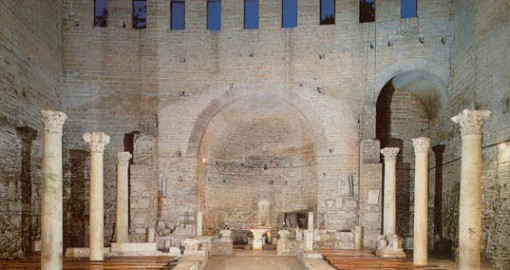
Picture of the Catacomb of St. Domitilla. Picture courtesy of stay.com/rome/attractions/15403/catacombs-of-st-domitilla-catacombe-di-san-domitilla
The Catacombs of St. Domitilla are very unique and are the oldest underground burial sites in Rome. Above here is a picture of St. Domitilla where inside you will find early Christian artwork and paintings including the second-century fresco of the Last Supper. The catacomb of Domitilla has an extensive network of galleries and are named after one of the nieces of the Emperor Domitian. This was orginally the private cemetery of Domitilla. Domitilla’s husband Flavius Clemens was executed on the Emperor’s orders for being a Christian. She was sent and exiled to the island of Ventotene (then Pandataria).
Domitilla was so well preserved that it is the only catacomb that contains bones still today. It’s not just the oldest but it is also the largest catacomb of Rome. It contains more than ten miles of corridors and almost 150,000 burial spots. It provides us with insight into all phases and phenomena of an early christian necropolis. Here you will find the a sanctuary with the graves of the martyrs Nereus and Achilleus up to the middle ages.
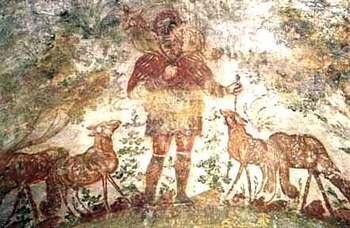
Picture of the Good Shepard. Picture courtesy of http://www.sacred-destinations.com
One of the oldest parts of the catacomb can be found just right of the basilica. At this spot members of the Flavian family were all buried and there is a cubiculum with a fresco of Christ as the Good Shepherd. The catacomb also has another part known as the area of the Virgin (della Madonna) and is adorned with various third and fourth century paintings. The most famous of these shows the Magi approaching the Virgin and child. Through catacombs we are able to see early Christian ways and how they expressed themselves and their religion through their artworks in their catacombs.
Bibliography
J Stevenson, The Catacombs: Rediscovered monuments of early Christianity, Thames and Hudson, 1978 pp.25-28
en.wikipedia.org/wiki/Catacombs of Rome#Catacombs of Domitilla
J. P. Richter, The Burlington Magazine for Connoisseurs, Vol. 6, No. 22 ( Jan. 1905). pp. 286-289
Pictures: Catacomb of Domitilla- stay.com/rome/attractioins/15403/catacombs-of-st-domitilla-catacombe-di-san-domitilla
Picture of the Good Shepherd – http://www.sacred-destinations.com
Filed under Uncategorized
The Roman Goddess Venus
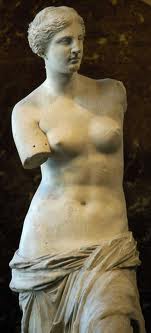
"Venus de Milo" Hamiaux, M., Les Sculptures grecques, II, Paris, 1998, no. 52, pp. 41-44
Venus is a Roman goddess of love, beauty, sex, sexual seduction and fertility. She had a large role in the Roman religious festivals and myths. The increasing Hellenization of Roman upper classes identified her as the equivalent of the Greek goddess Aphrodite.
Venus was born in the sea and first came to shore at Cyprus, floating on a scallop shell. There was a Golden Apple with “For the Fairest” written on the side. Venus, Juno Minerva (She was the goddess of women and marriage) and Minerva (she was the goddess of wisdom) all wanted it. They decided to let a man, Paris, judge between them. They were all so beautiful that he couldn’t make his mind up. So Juno said she would make him powerful. Minerva said she would make him wise. Venus offered him Helen, the most beautiful woman in the world. He chose Venus, and Helen. Unfortunately Helen was married to someone else, and when Paris carried her off to his home at Troy, her husband came with his allies to get her back. Paris and all his family were killed and Troy was destroyed. One of the few Trojans to survive the Trojan War was Aeneas, the son of Venus. He went to Italy, and was the ancestor of the Romans.
As a native Italian deity, Venus had few myths of her own. Because of this she took over many of the myths of Aphrodite and became identified with various foreign goddesses. One of the biggest accomplishments of the goddess Venus, was having a planet named after her. The planet was at first the star of the Babylonian goddess Ishtar and then of Aphrodite. Because of her association with love and with feminine beauty, the goddess Venus has been a favorite subject in art since ancient times; notable representations include the statue known as the “Venus de Milo” (c. 150 BC) (ABOVE) and the painting “The Birth of Venus” (BELOW) by Sandro Botticelli.

"The Birth of Venus" E.H. Gombrich, "The Story of Art"
Gombrich, E.H. The Story of Art. London: Phaidon Press, Ltd, 1995.
Hamiaux, M., Les Sculptures grecques, II, Paris, 1998, no. 52, pp. 41-44
Hill, Dorothy Kent. “Venus in the Roman East.” Hill, Dorothy Kent. The Journal of the Walters Art Gallery. Baltimore: The Walters Art Museum, 1968/1969. 6-12. <http://www.jstor.org/stable/20168912
Lindemans, Micha F. “Venus.” 26 May 1999 . Encyclopedia Mythica. 28 November 2011 <http://www.pantheon.org/articles/v/venus.html>.
Filed under Uncategorized
 What song the Sirens sang . . .