Roman Archers

Archers and their tools in ancient Rome were a crucial part of their tactics. Though not until the battle of Carrhae in which the Parthians archers defeated the Romans, did Rome began to increase the number of bowmen from 500-700 in a Legion to 11,000.

Some of the tactics used was “a line of auxiliary pikemen backed by bowmen stood before [the] legion” (p.97, Archer), and they were “mingled with slingers to provide a protective screen against cavalry attacking flanks, [or] spaced out among heavy infantry chiefly on the wings” (p.91, Peddie).

The bow they used was adopted from the Turk’s it was “3 ft 9 in in length when measured along its outer curve and 3 ft 2 in when fitted with a bowstring of 2 ft 11 in. The war arrow it discharged measured 2 ft 4 ½ in in length and required a draw weight of 118 lb to pull the bowstring back to its full capacity” (p.89, Peddie).


The arrows that were used could have various aides to help their lethality. The best known was flaming arrows, “the Roman philosopher Lucretius had written that fire became a weapon as soon as men learned to kindle sparks” (p.208, Mayor) this holds true today. The “arrows [were] wrapped with flammable plant fibers (flax, hemp, or straw) and set afire” (p.209, Mayor), “Later, incendiary mixtures were packed inside the wooden shafts” (p.213, Mayor).

There were poison arrows but they seem to be used by the “enemies” of Rome not by Romans, this I think stems from the idea that to poison a weapon would be an act of cowardice.  The general Licinius Lucullus, who’s Asian campaigns were less than ideal, faced a revolt thanks in part to the “double arrow-points of iron, [that were] poisoned” (p.246, Mayor).

The Romans, being good at using others for their army did not falter on the archers, as Josephus wrote about the use of “Arab bowmen” by “Vespasian, at Jotapata” (p.91, Peddie).


Bibliography

1: Adrienne Mayor, Greek Fire, Poison Arrows & Scorpion Bombs: Biological and Chemical Warfare in the Ancient World (Woodstock: Peter Mayer Publishers, Inc. 2003), 208-209, 213, 246.

2: Christon Archer, John Ferris, Holger Herwig, and Timothy Travers, World History of Warfare (Lincoln: University of Nebraska Press, 2002), 97.

3: John Peddie, The Roman War Machine (United Kingdom: Alan Sutton Publishing Ltd. 1996), 89, 91.

4: Josephus, op. cit., III, p.220.

5: Roman Archer Mosaic: www.levantia.com.au
3 Comments

Filed under Uncategorized

Who Were the Vestal Virgins?

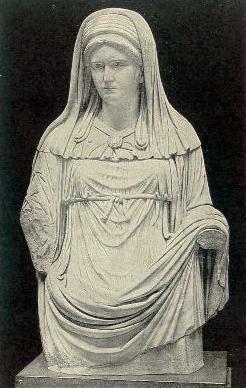
Roman depiction of the Virgo Vestalis Maxima Photo Courtesy of en.wikipedia.org /wiki/Vestal_virgins

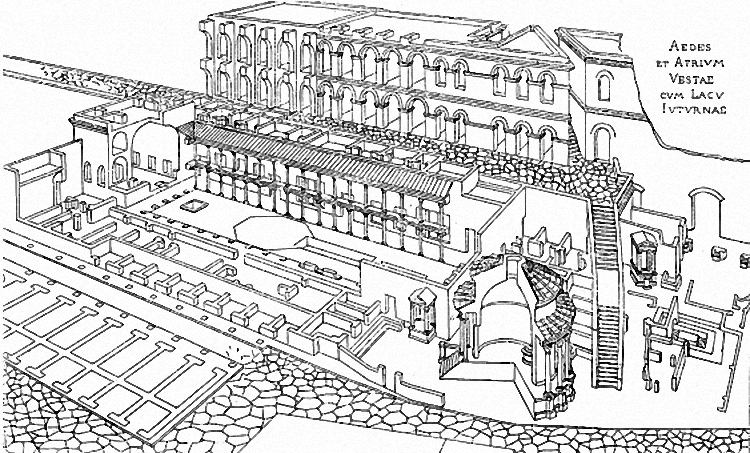
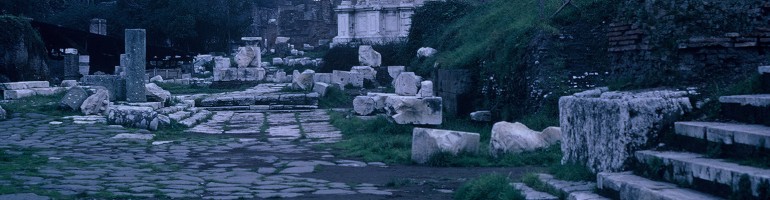
The earliest mention of the Vestal Virgins is associated with the Romulus and Remus myth, when their Mother was made a Vestal by her Uncle.  It was supposed to have been an honor, but in truth it was a means of depriving her from ever having children. (Livy, Book 1. 3.11)  In reality the Vestals played an important part in Roman public life.  Tradition has it that the Vestals Virgins were instituted by King Numa.  Both Livy and Plutarch write of his role in the Vestals lives and the roles that they played.  But who were these women?   With their number fixed at six, they were appointed between the ages of six and ten, and had to be daughters of respectable citizens, frequently were the daughters of Italian nobles.  When a vacancy occurred, twenty girls would present themselves to the Pontifex Maximus, head Priest over the Vestal Virgins, who would, chose one from amongst the candidates.  She would then serve for thirty years.   “During the first decade they were to learn their duties, during the second to perform their duties they had learned, and during the third to teach others these duties.” (Plutarch, 10.1-3)  After their thirty years, they were free to chose a new life, even marry if they wanted.  Most Vestals chose not to leave and seek a new life once their service was over.  During their thirty years they lived in the spacious atrium Vasae at the east end of the Forum. (See inserted photo below)  “Their duties were: to keep the sacred fire burning in the adjacent round temple of Vesta (they took turns watching it), to keep the temple clean, sprinkling it with water that they fetched themselves, to sacrifice daily at the sacred hearth, and to take part in various religious ceremonies about the city.  Wills and treaties might be entrusted to them for safe keeping.” (Cadoux)  King Numa bestowed great privledges upon the Vestals.  In exchange for remaining chaste and pure, they were assigned a stipend fro the public treasury, they had the right to own property, make a will during the lifetime of their fathers, transact and manage other affairs without a guardian.  While out performing their duties in the cities, if they happened upon a criminal on his way to his execution, she could pardon him.  But these had to chance meetings and not prearranged.   

A reconstruction of the House of the Vestals by Christian Huelsen (1905). Photo Courtesy of en.wikipedia.org/wiki/Vestal_virgins.

             Next to the Vasae was the round temple, where the sacred fire burned.  This fire was renewed annually on 1 March, the original New Year’s Day in Rome.  “This fire was a pure fire and might not be fed with wood from dead trees, nor might any rubbish be thrown upon it, or any impious act done in its presence.  If the Vestal Virgins allowed the fire to go out, they had to make anew one by drilling a hole in a board of ‘lucky wood,’ until a flame was produced by friction. The fire was then carried into the temple in a bronze sieve and the defaulting priestesses were whipped.  Since the temple guarded the nameless ancestors upon whose power rested the power of Rome itself, along with all things related to the prosperity of Rome,” punishments for even minor infractions were swiftly dealt out. (Prowse)  For minor offenses, the virgins were punished with whippings upon her bare back.  The most grievous infraction was giving up her virginity/chastity, for this she was condemned to being buried alive in a small chamber near the Colline Gate.  “From Tarquin to 113 B.C. eleven instances of executions of unchaste Vestals were recorded, and two more again in 76.  In only a few cases were the executions of their paramours mentioned.” (Cadoux).  The Vestal Virgins remained until the Emperor Theodosius in 394, when he ordered them disbanded and the fire extinguished.


Bibliography

“A reconstruction of the House of the Vestals by Christian Huelsen (1905).”

      http://en.wikipedia.org/wiki/Vestal_virgins.  (accessed: 23 Nov 2011).

 Cadoux, T.J., “Catiline and the Vestal Virgins.” Historia: Zietschrift fur Alte Geschichte 54 no. 2

      (2005). http://www.jstor.org/stable/4436764. (accessed 20 Nov 2011).

Livy, Book I. 1919 Loeb translation

Livy, Book V. 1929 Loeb Translation

Plutarch Lives, Numa.  1914 Loeb translation

Prowse, K.R., “The Vestal Circle.” Greece and Rome, Second Series 14 no. 2 (Oct., 1967).

            http://www.jstor.org/stable/642454. (accessed: 20 Nov 2011).

“Roman depiction of the Virgo Vestalis Maxima.”  http://en.wikipedia.org/wiki/Vestal_virgins.

      (accessed: 23 Nov 2011).


3 Comments

Filed under Uncategorized

Roman Theatre

The Roman Theatre was influenced by three different things these were “Greek Drama, Etruscan (circus-like elements) and Fabula Atellana (Atellan farces: Atella was near Naples)” (p.2, Trumbull). The “actors/performers were called histriones” (p.2, Trumbull). The plays were performed during the day, around lunch. “The characters wore Greek dress, with or without masks. Paint and wigs were employed, a gray wig for an old man, black for a young man, and red for a slave” (p.1, Bellinger).

The slave was a staple in most plays; both Terence and Plautus used them extensively. In Plautus’s play “Pseudolus,” the slave owner Ballio shows how slaves were treated, as noted in this seen “Ballio: You who’s got the ax, look after chopping the wood. Slave: But the ax’s edge is blunted. Ballio: Well; be it so! And so are you blunted with stripes, but is that any reason why you shouldn’t work for me?” (p.1, Davis).

The early Roman theaters “were built of wood at the foot of a grass-covered slope, the stage was a narrow platform, elevated, and backed by a simple architectural design. There was no curtain, no scenery that could be changed, no sounding board to carry the voice. An altar was placed on the stage, in front of the set. The audience [would] either reclined, stood, or sat on stools brought from home” (p.1, Bellinger). As time went on theaters started to refine, Pompey the Great “erected the first permanent theater in Rome. It was of stone, seated perhaps seventeen thousand people [it] was situated on the Campus Martius on level ground, and had separate sections for knights and senators” (p.2, Bellinger).

Though there have been advancements in the comfortably of where one sees plays, we still enjoy the same basics that the ancient world did, from actors and costumes to “good” written shows.   

Bibliography

1: Bellinger, Martha. “What the Roman Play was like” A Short History of Drama (1927): 1-2. http:www.thetheatrehistory.com/ancient/bellinger002.html.

2: Davis, William. “Pseudolus, Act. I, Sc. 2” Readings in Ancient History: Illustrative Extracts from the Sources, 2 Vols. (1912-13): 1. halsall@murray.fordham.edu.

3: Trumbull, Eric. “Introduction to Theatre” Roman Theatre (2007): 2. http://novaonline.nvcc.edu/eli/spd130et/roman.htm.

Image

“Ancient Roman theatre in Merida” medievalists.net.

1 Comment

Filed under Uncategorized

Ancient Roman Children’s Toys and Games

Little horse on wheels, Ancient Greek child's toy. From a tomb dating 950-900 BCE, Kerameikos Archaeological Museum, Athens http://upload.wikimedia.org/wikipedia/commons/1/15/Little_horse_on_wheels_(Ancient_greek_child's_Toy).jpg

The youth in Rome had a variety of activities for play and for exercise.  Some of the most common included jumping, wrestling, boxing and racing.  Activities for the wealthy also included hunting and fishing.  The Romans played many hand games including one similar to ‘handball’ that we still play nowadays.  A few examples of toys include:  balls, board games, hobbyhorses (which is in the picture above), kites, tiny models of people and animals. The ancient Romans played with hoops, with pieces of metal on them, like bells, to jingle and warn people in their way. Boys walked on stilts and played games with balls. They played tic-tac-toe, and a game called “knucklebones”, which is a lot like jacks, only played with bones.  The boys played many war-type games. They played war, and fought with wooden swords. A popular games was a game called “Troy” (lusus Troiae) where a whole pack of kids outnumbering you, who’d try to drag you across a line. Gambling, board games and dice games were also activities the Romans would entertain themselves with.  The girls played with dolls that were made of wax or terracotta (shown in the picture below), sticks, bows and arrows, and yo-yos. When Greek children, especially the girls, came of age it was tradition for them to sacrifice the toys of their childhood to the gods. On the eve of their wedding, young girls, around the ripe old age of fourteen, would offer their dolls in a temple as a rite of passage into adulthood.  After this event women were no longer allowed to be involved in these activities.  Those women, who were in wealthy families, were able to throw dinner parties that could possibly have dancing, poetry readings or music as forms of entertainment.  Smaller children were able to entertain themselves with small toys or games such as leapfrog. 

BBC. Romans: Family and children . 2011. http://www.bbc.co.uk/schools/primaryhistory/romans/family_and_children/ (accessed November 7, 2011).


BIBLIOGRAPHY

BBC. Romans: Family and children . 2011. http://www.bbc.co.uk/schools/primaryhistory/romans/family_and_children/ (accessed November 7, 2011).

Rostovtzeff, Mikhail. “A History of the Ancient World: Rome.” In A History of the Ancient World: Rome, by Mikhail Rostovtzeff, 387. Cheshire, CT: Biblo and Tannen Booksellers and Publishers Inc., 1927.    <http://books.google.com

ThinkQuest. The Life of a Roman Child. June 2010. http://library.thinkquest.org/CR0210200/ancient_rome/children.htm (accessed November 7, 2011).

3 Comments

Filed under Uncategorized

Mars: The God of War

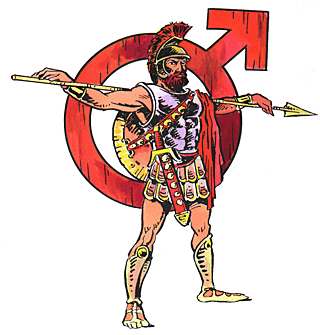
Mars the God of War. This picture is courtesy of en.wikipedia.or

 Today there is war just like in the days of the Roman Empire and the Roman Republic.  The early religion of the Romans was originally a simple animism (a belief in spirits or powers).  These spirits were not personified and not imagined as humans in form.  There was no statues of gods and no temples.  This religion established was a for a simple agricultural people.  As the Romans came into contact with other people and religions their own religion changed.  Divinities of conquered communities were brought into the pantheon of Roman gods.  It is believed that Etruscan kings built the first temples in Italy and set up the first statues of gods.  Contact with the Greeks led to the introduction of the Greek gods and Greek ritual.  The Religion of Numa is said to have organized the first priestly colleges.  The important of these priests were Jupiter, Mars and Quirinus.  Priestly colleges were groups of priests organized to perpetuate certain rights.  Salii (dancing priests) made up a famous college that worshiped Mars, the god of war.

Mars the god of war and agriculture was one of the twelve Olympian Gods.  He was the son of Jupiter and Juno.  Jupiter was said to be the greatest of all the gods.  It is said that his symbol is a vulture, a wolf and he often carried a bloody spear.  The Romans and Greek intertwined their religions and gods.  Mars would be equivalent to the Greek god of war Ares.  March 23 a festival called Tubilustrium was held in honor of Mars.  The sacrifices that were preformed to Mars were in correspondence to the Roman way of sacrifices.  The sex of the victim had to correspond to the sex of the god to whom it was offered.  White animals were given to the gods of the upper world and black victims to the gods of the underworld.

I will give you a couple of examples of ancient prayers and religious chants that have been preserved.  The first one is a powerful chant of the Arval brothers handed down in an inscription of A.D. 218:

“Come hither, you Lares, help,

let no plague, disaster, Mars break in upon the throng.

Wild Mars, take your fill, jump on to the threshold and stay there.

All the Semunes shall he invoke in turn.

Let Mars come to our aid

Triumph, triumph, triumph, triumph, triumph”

As we can see the beliefs in the existence of gods and in the practical applications of their power are not only present in the religion but also their prayers.  Pray is predicated on the belief that gods can and will respond to requests with actions in the material world when called upon.  The next example considers one of several prayers that Cato recorded about Mars the god of war and agriculture.

“Father Mars, I beg and entreat you to be well disposed toward me and toward our house and household.  I have ordered an offering of pigs, sheep, and bulls to be led around my field, land, and farm on account of this request, so that you may prevent, ward off, and remove sickness, both seen and unseen, and barrenness and devastation, and damage to crops and bad weather, and so that you may permit my legumes, grain, vineyards, and shrubbery to grow and turn out well.  Preserve my shepherds and flocks unharmed and give good health and strength to me, my home, and our household.  For this purpose, to purify my farm and land and field and to make an expiatory offering, as I said, be increased by these offerings of suckling pigs, sheep, and bulls that are to be offered.  Father Mars, for this same reason, be increased by these offerings of suckling pigs, sheep, and bulls.”

Mars the God of War and his symbol. This picture courtesy of http://www.wordsources.info./mars.html

As we see here prayer for the Romans was an important part of their lives that they inherited and formed from other people and their religions.  Mars played an important role in the Romans life not only for deliverance from their enemies during war but also for their farms and houses.

Bibliography

Mary Johnston, Roman Life: Successor to Private Life of the Romans (Chicago: Scott, Foresman and Company,1957), 340,349

Karl Christ, The Romans: An Introduction to their History and Civilisation (Berkeley and Los Angeles: University of California Press, 1984), 158-159

Charles King, “The Organization of Roman Religious Beliefs,” Classical Antiquity, vol. 22 No. 2 (October 2003), pp. 275-312

Pictures

Picture of Mars statue: en.wikipedia.org

Picture of Mars with spear: http://www.wordsources.info./mars.html

3 Comments

Filed under Uncategorized

Encaustic Painting

Pliny the Elder’s, Natural History is our earliest written record of the encaustic style of painting.  As he states, no one knows who the inventor of “painting in wax” was, but it was agreed that the most famous painter of this techniques was Pausias of Sicyon. (Pliny, 35:39).  During the period of the Roman Empire there were only three types of encaustic painting, with wax and on ivory with a graver or cestrum, a small pointed graver, and on battleships.  Pliny writes of this last art form, “that of employing a brush, when wax has been melted by fire; this process of painting ships is not spoilt by the action of the sun nor by salt waters or winds.” (Pliny, 35:41)

Encaustic means “burning in” and is applied to this art form since the wax portrait is literally fixed through the aid of fire.  This painting process begins with mixing beeswax with different pigments to obtain the desired color.  The colored wax would then be prepared as either cakes or sticks.  Prior to beginning the painting process, the artist would sketch the portrait or scene on the medium.  Once the outline was finished, the artist would choose either a hot or cold painting technique.  If they chose the hot process, the wax was laid on quickly with brush strokes, using a thinner wax mixture of the background, garments, and facial features.  For this process the painter would employ the use of a heated rhabdion, which varied in shapes similar to today’s paint brushes.  Once the wax cooled, a hand tool would be used to blend in flesh tones to the face and neck.  If the artist chose a cold application, the beeswax would first have to be softened to work with by adding either eggs or oil to the wax.  This mixture is referred to as Punic Wax.  Since it took longer for the cooler wax to dry, this was a preferred method since it gave the artist more control and time to fix mistakes.  Once the painting was finished, the painter would then “burn” the wax.  It is unclear how they did this exactly.  When “painting” on ivory, the artist would use a cestrum, or viriculum to etch the design into the ivory first.  It is not thought that this form of art was detailed due to the firing process when completed.  The final painting process was called the pencillum encaustic.  Here instead of using hard wax cakes or sticks, the wax was kept in pots dissolved previous to painting, so that the painter could use an actual paint brush instead of the metal tipped rhabdion.  When the painting process was finished, the painter would then hold it over a cauteruim, a pan of hot coals or charcoal heater, until the wax was set.

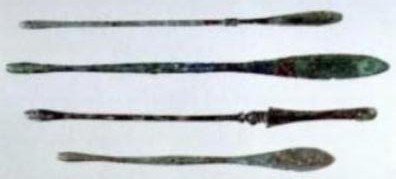
Encaustic Painting Knives from Pompeii Photo Courtesy of http://www.encausticcumi.com/ESW/Images/pic_3076.jpg

While the most famous painter was a male, throughout history, and even mentioned by Pliny himself, there have been many female encaustic painters.  It is through one of these females that we know exactly what types of tools they employed.  “She, an encaustic painter, had been buried with her tools: reed brushes, bronze cauteria and a bronze box to contain live coals with a rhabdion, a silver top that was used as a plalette.” (Hansen, 2)

Today the painting process has not changed much.  The wax is prepared differently, and in most cases is softer than the original recipe.  In addition to “updating” the wax recipe, the “burning in” process has changed.  Originally, the artist would use simple metal tools and then burn in the artwork through the use of a cauteruim or direct heat.  Today’s encaustic artist employs hot plates to heat their wax and propane torches to “burn in” the process.

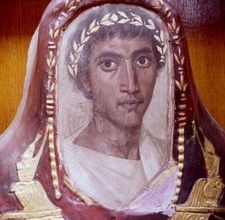
Although we can read about the great works of art done in the encaustic method, today we are left with few examples from antiquity.  The majority of this art from can be found on mosaic tiles, or in Greek mummy portraits dating to 160-180 AD.  These Egyptian portraits give us our best views of what people looked like and dressed so long ago.

Funeral Encastic Painting Photo courtesy of ehow.com

Bibliography

Encaustic Painting Knives, http:www.encausticcuni.com/ESW/Images/pic_3076.jpg (accessed: 9

Nov 2011).

Funeral Encaustic Painting, http://www.ehow.com/how 8541836_paint-encaustic-paint.html.  (accessed: 20 Nov 2011)

Hansen, Harold J., “The Development of New Vehicle Recipes for Encaustic Paints.” Leonardo 10

no. 1 (Winter 1977): 1-5.  http://www.jstor.org/stable/1573618 (accessed: 9 Nov 2011).

Pliny, Natural History. 1952 Loeb translation

The Metropolitan Museum of Art.  http://www.metmuseum.org

“Wax Painting or Encaustic.” The Crayon 6 no. 5 (May 1859): 148-149.  http://www.jstor.org/

Stable/25527899 (accessed: 9 Nov 2011).

3 Comments

Filed under Uncategorized

Elephant, Romans and Horses.

In 280 BC King Pyrrhus attacked Rome “the Romans had never seen elephants before, [and] the elephants wrecked havoc” (p. 81, Ward) on the Roman phalanx. Though Rome would eventually defeat Pyrrhus, this first taste pf pachyderm warfare was to be a good lesson for the future.

When the Punic Wars kicked off Rome was somewhat accustomed to elephants, yet the shock of Hannibal crossing the Alps with them did unhinge the first combat group to face him in Northern Italy. Hannibal’s folly at the Battle of Zama, using under trained elephants as “the battle began with the elephant charge at the center of the Roman line. Hannibal ordered the drivers of his elephants to charge the enemy but when the sound of trumpets and bugles pierced the air all around them, some of the animals panicked, turned tail and stampeded to the rear. Then finally all the beasts took fright: some of them escaped by way of gaps between the maniples through which the Romans allowed them to pass, in the end [the elephants] stampeded clean off the battlefield.” (p. 133, Kistler). After this Scipio leveled terms against Carthage to include that they could not “keep or train war elephants” (p. 134, Kistler).

Livy in History of Rome notes how Roman “legions gave [some of] the beasts to an ally in Western Turkey. [And] the elephants were immediately useful in repelling a Gallic invasion only a year later” (p. 107, Livy)(p. 146, Kistler). Other than the elephants initial training there was no indication that the peoples of Western Turkey knew how to utilize them. Good weapons to have on your side.

From 171 BC to 168 BC the Romans would use elephants to their advantage in the Macedonian Wars, in which King Persus of Greece would battle it out with Rome. The first battle Persus witnessed in horror as his cavalry horses lost their minds when faced with the opportunity to go too the horse-promise land via a ton of angry elephant,

the battle was lost, in his (Persus’) retreat he came up with a plan to “train” his horses so as not to have a repeat performance. So “in order to make sure that the beasts should not prove a source of terror to the horses, he constructed images of elephants and smeared them with some kind of ointment to give them a dreadful odor. They were terrible both to see and to hear, since they were skillfully arranged to emit a roar resembling thunder; and he would repeatedly lead the horses up to these figures until they gained courage.” (p. 147, Kistler). This was to no avail for when he crossed again in battle with the Roman elephants his cavalry failed again to Persus’ undoing.

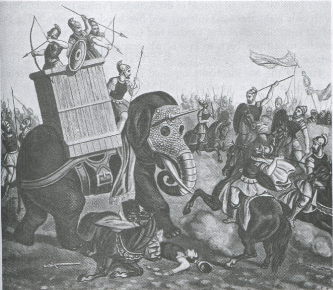
We should now turn to some common terms one sees with trained war elephants. First is the Howdah this is the wooden box that is put on the back of the elephant for men to ride in. Second is the Mahouts these are the men who control the elephants normally riding on the neck. Third is the Archers who were the most common warrior in the howdah shown in this picture.

1. John M. Kistler, War Elephants (Lincoln: University of Nebraska Press, 2007), 133-134, 146- 147.

2. Livy, Livy. History of Rome: in 14 volumes (Cambridge: Harvard University Press, 1961), Vol. 9, 107.

3. Allen M Ward, Fritz M. Heichelheim, and Cedric A. Yeo, A History of the Roman People: Fifth Edition (Upper Saddle River: Prentice Hall, 2010),81.

4. J. G. Wood, Sketches and Anecdotes of Animal Life, second series (London: G. Routledge, 1858), 27. As seen in War Elephants, 63.

5. T. H. McAllister, Armored Elephants (George Eastman House, 1890’s). As seen in War Elephants, 91.

2 Comments

Filed under Uncategorized

Ancient Roman Legal Marriages

When people get married today it usually involves lots of planning and money and where the wedding is going to take place.  We never really think of is this wedding going to be legal or illegal.  This was definitely an issue during the late Republic and into the Imperial period in Rome.  Marriages required no formal ceremony to be valid.  Cohabitation between eligible partners basically created marriage.  Most historians today would agree that marriages within village or ethnic units, social classes and status groups were common in the communities that constituted Roman society   Slaves could not legally get married but all Roman citizens could whether they be freeborn or freed, could marry another Roman citizen of the opposite sex unless disqualified by not meeting certain conditions before a legal marriage could be contracted.

  • Girls must be at least twelve years old, boys must be fourteen, at the time of marriage.
  • Freeborn citizens could not marry persons associated with “unsavory occupations” for example: prostitution, acting, tavern keeping, and women who had been convicted of adultery.
  • Too close a degree of relationship could prohibit marriage.
  • Soldiers could not marry during their term.
  •  Governors could not marry women resident in their provinces during their governorship.
  • From the second century A.D. guardians could not marry their wards.
  • In addition to the above restrictions, members of senatorial families couldn’t marry persons of freed status.

Both parties involved in the marriage must be adults.  There could be no marriages between children.  Both man and woman had to be unmarried and polygamy was never practiced in Rome.  The two getting married couldn’t be closely related and in general marriage was absolutely forbidden between ascendants and descendants.  If all of these conditions were met between man and woman they might legally be married.  Certain distinctions might affect the civil status of their children.  If all requirements were fulfilled and both were Roman citizens the marriage was legal and the children by birth were legitimate with all civil rights.  If one of the parties in the marriage was a Roman citizen and the other member did not have full Roman citizenship, the marriage was still legal.  The children always took the civil standing of their father.

Roman citizens then had to live up to these requirements to be classified as a legal marriage.  The Christian church era of Rome changed a few of these rules as time went on.  At least now days we don’t have to worry about some of these things but the stress is still there.

Bibliography

Brent D. Shaw and Richard P. Saller, Close-Kin Marriage in Roman Society?, Man, New Series, Vol. 19, No. 3 (Sep., 1984), pp. 432-444

Beryl Rawson, Roman Consubinage and Other De Facto Marriages, Transactions of the American Philological Association (1974). Vol. 104 (1974), pp. 279-305

Mary Johnston, Roman Life: Successor to Private Life of the Romans, (Scott, Foresman and Company, Chicago, 1957) pp. 129-130

Photo: http://yourweddingisaboutyou.wordpress.com/2009/11/02/ancient-roman-weddings/ancient-roman-wedding-betrothal-jg-2/

2 Comments

Filed under Uncategorized

The Beginning of Education in Rome

A Roman School from an ancient Relief in Trier. Johnston, Harold Whetstone. The Private Life of the Romans. 1932. http://www.forumromanum.org/life/johnston_4.html (accessed October 13, 2011).

In the beginning of the Roman Empire, Rome did not have any public education set up.  Most of the education at this point was done through the families.  In the family the children were taught the techniques for farming, physical skills for war, Roman traditions and legends, and the young boys were taught about public affairs. 

In the 2nd and 3rd centuries B.C. the Roman’s contact with the Greek world during the Macedonian Wars inspired new ideas about education.  Now the richest Romans wanted their children to learn about Greek studies.  Many of these children who were exposed to this education later served Rome as administrators, officials, and possibly even members of the Senate.  In this new idea of education there was the concept of “humanitas,” which was an education in the liberal arts or humanities.  They hoped that this would help students to be well-rounded and not too focused in one area.  Romans thought it essential to have a complete knowledge of Greek which led to the beginning of schools being taught by professional scholars.  At the very top is a relief with a scene of a roman school.

Think Quest. Elementary Schools in Ancient Rome. September 11, 2011. http://library.thinkquest.org/J002606/AncientRome.html (accessed October 13, 2011).

Those who had lots of money were able to provide tutors for their children.  Those who did not have very much money went to private schools that were taught by educated Greek slaves.  At school kids would wright on wooden tablets coated with wax. A sharp stick made of iron or bronze was used to incise letters into the soft wax of a writing tablet. The stick was called a stylus. The broad flat end of the stylus was used for erasing. There is a picture of these above.  Children were taught the basics of reading, writing and arithmetics.  By the age of twelve or thirteen, those children who showed promise could attend the “Grammaticus” which was the school for grammar.  The standard curriculum in the liberal arts included literature, dialectics, arithmetic, geometry, astronomy, and music.  The core if the curriculum was Greek literature.  The students were exposed to the philosophies of Plato, Aristotle and Zeno of Elae, along with the histories of Herodotus and Thucydides along with many others.  Most of the Romans were bilingual; they knew both Latin and Greek.  The brightest students would end their education studying Greek oratory.  Many of the best schools were located in Athens. 

Along with all of these schools were also libraries to hold books. Books were treasured possessions but were usually owned privately.  Because of this, in many wealthy Roman households, there was usually a slave called a “copyists” who copied books.  By A.D. 400, Rome had more than thirty libraries in existence; the most important one was located at Alexandria.  It was a giant storehouse of knowledge.

The Romans were extremely intellectual people and the addition of an education system into their everyday lives had an outstanding impact on their grown and prosperity.


Bonner, Stanley Frederick. Education in Ancient Rome: From the Elder Cato to the younger Pliny. Oakland, CA: University of California Press, 1977.

Johnston, Harold Whetstone. The Private Life of the Romans. 1932. http://www.forumromanum.org/life/johnston_4.html (accessed October 13, 2011).

Kreis, Steven. A Brief Social History of the Roman Empire. August 4, 2009. http://www.historyguide.org/ancient/lecture13b.html (accessed October 13, 2011).

Think Quest. Elementary Schools in Ancient Rome. September 11, 2011. http://library.thinkquest.org/J002606/AncientRome.html (accessed October 13, 2011).

3 Comments

Filed under Uncategorized

Teuta: The Pirate Queen of Illyria

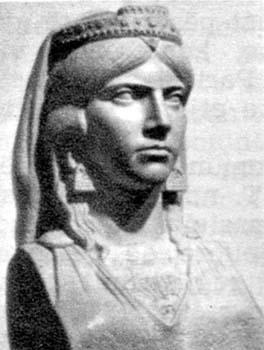
Queen Teuta of Illyria Photo courtesy of http://www.illyrians.org

          After a successful campaign against the Aetolians in 231BC, King Agron of Illyria “took to carousals and other convivial excesses, from which he fell into a pleurisy that ended fatally in a few days.” (Pol 2.4.6)  Upon his death Teuta was appointed regent for her stepson, Pinnes.  At the time, piracy was a normal means of business against everyone in the Adriatic Sea, to include the Italian shipping trade.  For the most part, Rome ignored the activities of the Illyrians, until the Illyrians began to occupy northern Epirus.  As acting Queen, Teuta handed out letters of marquees to her captains allowing them to pillage as they saw fit.  It was not until the Roman Senate started being approached by merchants who had lost their ships and goods to the Illyrian Pirates, that they felt compelled to step in and put a stop to Teuta.  They sent two ambassadors, Gaius and Lucius Coruncanious to approach Teuta, in hopes that she would put a stop to her pirating.  Unfortunately for Rome, Teuta was quite pleased with the revenue she was receiving from her pirates.  About the same time the ambassadors arrived in Illyria, Teuta was busy putting down revolts within Illyria and besieging Issa, who refused to submit to her reign, probably not the best time for the ambassadors to seek an audience.  Being distracted, Teuta listened half-heartedly to the ambassadors’ pleas, replying that “she would see to it that Rome suffered no public wrong from Illyria, but that, as for private wrongs, it was contrary to the custom of the Illyrians kings to hinder their subjects form wining booty from the sea.” (Pol. 2.8.8)  The younger ambassador stepped forth and told her in plain language that he disagreed with her countries customs, and hoped that they would change them to suit the Romans.   Teuta’s response to this personal insult was to order the assassination of the younger ambassador.  Upon Rome hearing of this assassination, they sent armed fleets with legions over to Illyria, the beginning of the First Illyrian War.  Teuta, being forewarned of the invasion, seized all the possible landing spots for the Roman ships along the Illyrian coasts and started besieging the cities that were under Roman control.  She was very successful, and possibly could have held off and won the war, if not for Demetrius, a high ranking Illyrian with designs on the throne for himself. He communicated with the Roman consul his willingness to hand over the island Corcyra and its Illyrian garrison.  This act of treason was the turning point in the Illyrian War.  From this point on the Romans slowly began to gain ground in conquering Illyria.  Facing defeat, Teuta, along with a few of her loyal followers, escaped to an island on the Rhizon River.  The Consul placed the majority of Illyria under Demetrius, practically making him the new regent, and returned to Rome.  In early spring 228BC, Teuta sent an envoy to Rome to sign a treaty ending the war.  Through her envoy, she agreed to pay all tributes that they imposed, to relinquish most of Illyria, and finally agree to not sail more than two unarmed ships south of Lissus at a time.  Lastly she reinstated Pinnes as the rightful ruler of Illyria.  Like Teuta’s life prior to her becoming regent, her life after losing Illyria to the Romans has become one of histories mysteries.  Demetrius later broke his treaty with Rome and declared himself King of Illyria, pushing aside the child Pinnes, and initiated the Second Illyrian War.  Pinnes was finally declared King in his own right but died at the age of 15 before he was able to actually rule. 

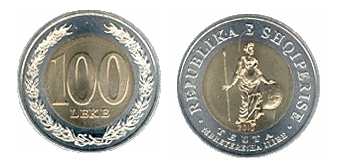
     There is only one true image of Queen Tueta from her time still available today, which is a bust of her.  It is currently being housed in a museum in Algeria.  In 2000, Algeria published her likeness on the reverse side of one of their coins.  It is unknown where that image came from.  There have been paintings done of her throughout time, but they are either done in the Greek style of later centuries, or portraying her in Elizabethian dress, which again is wrong.


Image of Queen Teuta on Albanian currency Photo courtesy of http://www.wikipedia.com


BIBLIOGRAPHY

 Badian, E. “Notes on Roman Policy in Illyria (230-210 B.C.).” Papers of the British School at Rome

      20(1952). http://www.jstor.org/stable/40310489 (accessed 6 Oct 2011).

 Eckstein, A.M. “Polybius, Demetrious of Pharus, and the Origins of the Second Illyrian War.” Classical

      Philology 89, no. 1 (Jan., 1994).  http://www.jstor.org/stable/269751 (accessed 11 Oct 2011).

 Polybius. Histories: Volume I  1923 Loeb translation.

“Queen Tueta of Illyria bust.” http://www.illyrians.org/images/queen%20Teuta%203rd%20Century%20BC.jpg (accessed

      12 Oct 2011).

Salisbury, Joyce E.  Encyclopedia of Women of the Ancient World. Santa Barbara, CA: ABC-CLIO, Inc.,

        2001.

Teuta of Illyria.  “Queen Teuta on the 100 Leke coin, issued in 2000.”  Wikipedia web site. 

      http://en.wikipedia.org/wiki/Teuta_of_Illyria (accessed: 13 Oct 2011).

6 Comments

Filed under Uncategorized